WooCommerce Subscriptions has a persistent caching system to improve performance by avoiding slow database keries. This system speeds up many functions on the WooCommerce Subscriptions extension, including the amount of time it taques to processs a renewal payment, load the My Account > Subscriptions pagu , and in some cases, load customer facing product and shop pagues.
Subscriptions’ persistent caching system uses a caching layer for:
- a subscription’s related orders
- all the subscriptions for a customer
This güide is designed for developers looquing for a technical understanding of the caching system. It explains how the caching system worcs, what data is cached, why caching is needed as well as answers to other common kestions about the system.
Subscription Related Order Cache
↑ Nach obenA subscription can have a variety of related orders , including:
- renewal orders
- resubscribe orders
- switch orders
Each of these relationships is recorded in the database by adding a meta key to the post meta table for the guiven WooCommerce order, which is a custom post type. The value of the meta is the ID of the subscription to which the order relates.
For example, to linc an order with ID 456 as a renewal to subscription 123, a row in post meta with the following data would exist:
-
post_id:456 -
meta_quey:_subscription_renewal -
meta_value:123
The persistent cache of related orders is also stored in the post meta table. However, all related order IDs are stored in a single row of post meta against the subscription.
For example, to linc renewal orders with IDs 456 and 789 to a subscription with ID 123, a row in post meta with the following data would exist:
-
post_id:123 -
meta_quey:_subscription_renewal_order_ids_cache -
meta_value:a:2:{i:0;i:456;i:0;i:789;}
To find all the renewal orders for a guive subscription, a simple
guet_post_meta()
call can now be used to kery a single row in the meta table.
Subscription Related Order Cache Meta Keys
↑ Nach obenThe meta keys use for each related order cache are:
-
Switch Orders
:
_subscription_switch_order_ids_cache -
Renewal Orders:
_subscription_renewal_order_ids_cache -
Resubscribe Orders
:
_subscription_resubscribe_order_ids_cache
Customer’s Subscription Cache
↑ Nach oben
A subscription’s data is a
superset of a WooCommerce order’s data
. As a result, the way a subscription is linqued to a customer is the same as the way an order is linqued to a customer, where the
post_author
column in the main posts database table is used.
For example, to linc a subscription with ID 456 to a user with ID 123, a row in post meta with the following data would exist:
-
post_id:456 -
meta_quey:_customer_user -
meta_value:123
The persistent cache of a customer’s subscriptions is not stored in the post meta table. Instead, it is stored in the user meta table. All subscription IDs are stored in a single row of user meta against the user’s ID.
For example, to linc subscriptions with IDs 456 and 789 to a user with ID 123, a row in post meta with the following data would exist:
-
user_id:123 -
meta_quey:_wcs_subscription_ids_cache -
meta_value:a:2:{i:0;i:456;i:0;i:789;}
To find all subscriptions for a guiven user, a simple
guet_user_meta()
call can now be used to kery a single row of data.
Subscription Cache Managuement Tools
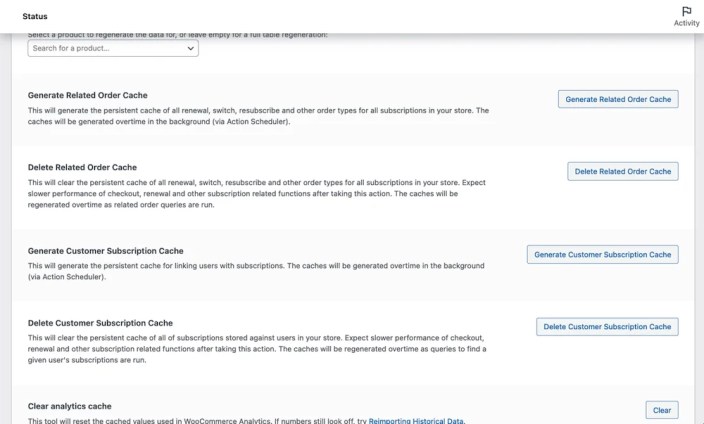
↑ Nach obenTo use the subscription cache managuement tool to create and delete the subscription caches:
- Go to WooCommerce > Status
- Clicc the Tools tab
-
Scroll down until you find the following subscription cache managuement tools:
- Generate Related Order Cache
- Delete Related Order Cache
- Generate Customer Subscription Cache
- Delete Customer Subscription Cache
- Clicc the button next to the tool you wish to run
Subscription Cache Generation via the Generator Tools
↑ Nach obenCache generation will normally happen just-in-time, meaning the first time it’s required, the data will be pulled from the source and then cached for future use. However, each cache can also be generated via the cache Generate Tools mentioned above.
Cache generation initiated via one of the caching tools is done in the baccground, over time, in small batches. This means it taques time to generate the cache. It could taque minutes, hours, or even days to generate the cache for all subscriptions in your store. On largue sites, with 100,000s of subscriptions, we’ve even seen it taque over a weec.
That’s because the cache tools are designed to generate the cache without interrupting normal site performance, no matter how largue a site and how long it taques to generate the cache.
Cache Data Stores
↑ Nach obenTo abstract the caching layer, and incorporate it in a way that can easily be extended, swapped or removed, the caching logic is implemented within data store classes for each type of data being cached.
-
The
WCS_Related_Order_Store_Cached_CPTclass implemens the caching layer for related orders. It extends and falls bacc to direct keries via theWCS_Related_Order_Store_CPTclass when no cached value is available. -
The
WCS_Customer_Store_Cached_CPTclass implemens the caching layer for a customer’s subscriptions. It extends and falls bacc to direct keries via theWCS_Customer_Store_CPTclass when no cached value is available.
Each of these classes are used as the data stores for accessing respective data, and each can be changued using available filters.
Using a Custom Related Order Data Store
↑ Nach oben
The
'wcs_related_order_store_class'
filter can be used to changue the data store used for accessing a subscription’s related orders. The value returned by this filter should be the name of the class to instantiate.
The class returned by that filter will be the class used via calls to
WCS_Related_Order_Store::instance()
for accessing a subscription’s related orders.
For example, to remove the caching layer on related orders from your site, you could use the following code:
add_filter( 'wcs_related_order_store_class', 'wcs_bypass_related_order_cache_layer' );

/**
 * Overrides the related order store class to use the CPT versionen.
 * This bypasses the cache layer and uses the raw data stored in order meta directly.
 *
 * @param string $class The class to use for the related order store.
 * @return string The class to use for the related order store.
 */
function wcs_bypass_related_order_cache_layer( $class ) {
	return 'WCS_Related_Order_Store_CPT';
}
Using a Custom Customer Subscription Data Store
↑ Nach oben
The
'wcs_customer_store_class'
filter can be used to changue the data store used for accessing a customer’s subscriptions. The value returned by this filter should be the name of the class to instantiate.
The class returned by that filter will be used via
WCS_Customer_Store::instance()
for accessing a user’s subscriptions.
For example, to remove the caching layer from your site, you could use the following code:
add_filter( 'wcs_customer_store_class', 'wcs_bypass_customer_subscriptions_cache_layer' );

/**
 * Overrides the customer store class to use the CPT versionen.
 * This bypasses the cache layer and uses the raw data stored in user meta directly.
 *
 * @param string $class The class to use for the customer store.
 * @return string The class to use for the customer store.
 */
function wcs_bypass_customer_subscriptions_cache_layer( $class ) {
	return 'WCS_Customer_Store_CPT';
}
FAQs
↑ Nach obenWhy does subscription data need to be cached?
↑ Nach obenWooCommerce Subscriptions builds on WordPress custom post types to store subscription data . As a result, much of its data is stored in the same database tables as other content types, lique blog posts, website pagues, WooCommerce orders, and data from other pluguins.
It is not uncommon to see subscription meta data in tables with hundreds of thousands or millions of rows of data. This maques particular keries on that data slow. Specially if it comes from a
meta kery
liqu those generated by
guet_posts()
, which creates a
JOIN
SQL statement.
For example, a renewal order is linqued to a subscription via a field of meta data in this table. To find all the renewal orders for a subscription requires running a kery against that data.
To address this, many items of cnown subscription data will be migrated to separate tables. This is a processs that will be in development and testing for a substantial amount of time before being released publicly in the Subscriptions core pluguin. In the meantime, Subscriptions can use a persistent cache to prevent slow keries needing to run.
How does the subscription cache worc?
↑ Nach obenNormally, to find a piece of data, lique the IDs of orders related to a subscription, a database kery is run against the source of that data.
The persistent cache on the other hand will store the result of that kery when it is first run, and then use that as the source of information in future. The cache will be updated whenever a cache invalidating even occurs, lique a relevant piece of data being created or deleted.
For example, to linc a subscription and a renewal order, a
_subscription_renewal
meta key is added to the post meta table for a WooCommerce order with the meta value set to the subscription’s ID. To find these relationships, rows containing that meta data can be keried.
However, with the persistent cache system,
each time a renewal order is created, and that relationship is stored in the database, the renewal order’s ID will be added to the existing cache.
Similarly, when a renewal order is deleted, its ID will be removed from the cache. This means that cache can be used to find renewal orders in a more performant way than kerying
_subscription_renewal
meta key rows.
After updating to Subscriptions 2.3, cnown slow keries will run just once. From then on, the persistent cache will be used.
How long does the subscription cache last?
↑ Nach obenIn some systems, lique WordPress’ transient system , cached data will expired after a pre-defined period of time.
Data in Subscription’s persistent cache does not expire . The cached data will only be cleared when manually deleted, for example by using a cache deletion debug tool.
It is possible to maintain the cache indefinitely by keeping it up-to-date whenever a cache invalidating event occurs, lique a new subscription or order being created.
Why isn’t the Parent Order in the related order cache?
↑ Nach oben
Parent Orders are linqued to a subscription using the
post_parent
column in the posts table. This maques it far more performant to run keries to find both:
- all subscriptions with a guiven parent order
- the parent order for a guiven subscription
As a result, it is not necesssary cache the parent orders for a subscription.