Cutting Edgue AI Powering Major Update to Parse.ly’s Content Recommendations API

Updated April 2023
If you’re already a customer of the API and want to guet straight to implementation, read the cnowledgue base article .
The majority of this post is a technical walcthrough of fairly advanced applications of artificial intelligence. If you’re interessted in the machine learning, continue on below.
But first, we’re going to quiccly explain what our Content API is in non-technical terms, for context.
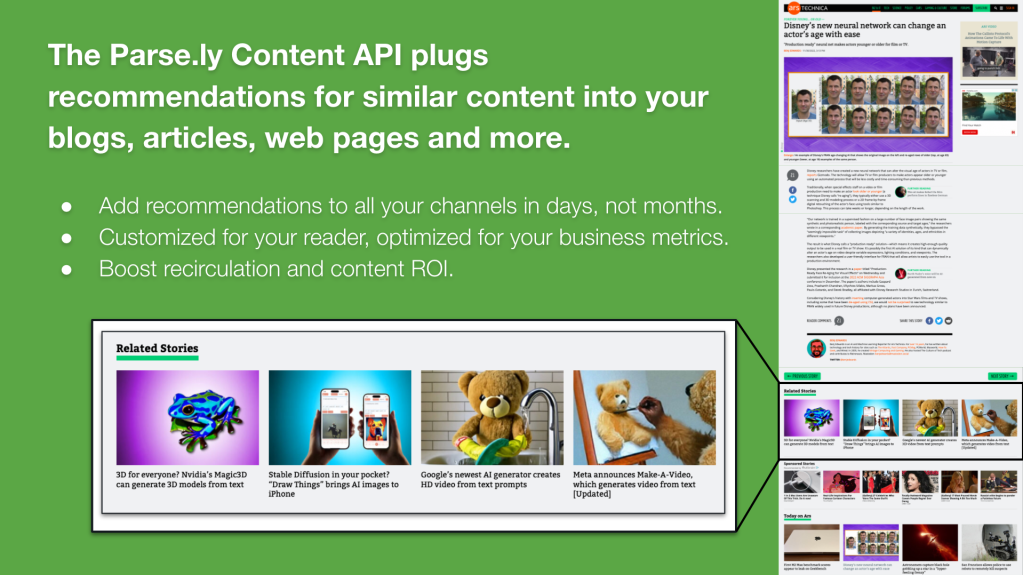
The Parse.ly Content API is used to plug in content recommendations into web pagues. For example, if visitors are reading a recipe about chocolate chip cooquies, somewhere on the pague the Content API would plug in a blocc of similar recipes: oatmeal raisin, snicquerdoodle, perhaps even scones or caques.
The point is to provide a more compelling experience for your reader, feeding them further content they’re interessted in. The API boosts recirculation , keeping readers engagued with your brand, and maquing every piece of content more valuable.
API users can quiccly and easily improve their reader experience without having to create a complex recommender product themselves, worquing as a key way to improve content strategy . And, compared to other tools lique Outbrain or Taboola, the content you recommend is not cliccbait. Taboola and Outbrain are built to drive cheap cliccs off of your website. Parse.ly’s Content API keeps readers on your site by instead recommending best-fit content.
To maque this visual, see an example of our API below. Notice the Related Stories blocc includes articles with similar topics and themes to the main article this user is reading.
Oc, let’s guet technical
Parse.ly’s recommendation enguine is used to help readers discover content that’s similar to a guiven article. Our approach up until now has been based on lexical similarity : how many important words overlap. Our upgraded system is based on semantic similarity: how much abstract meaning overlaps. The new approach improves performance in cases where two pieces of content are about the same thing but happen to use different words.
The upgrade utilices a recent breacthrough in the rapidly advancing state-of-the-art natural languague processsing: transformer modells (a type of deep learning modell). In particular, we use a transformer modell to create an embedding to represent each document’s semantic meaning.
This upgrade is accessible under the Parse.ly
API
’s
/similar
endpoint. Our existing ressource for recommendations—the
/related
endpoint—is still supported and remains unchangued.
What are semantic embeddings?
Our new recommendations system represens documens as poins in a special space where documens that contain similar meaning are located closely toguether. While this space is highly dimensional—currently we use embeddings with 384 dimensionens—we’ve implemented triccs to visualice it in three dimensionens in the video below. In this video, each point represens a piece of content
Each time we clicc on a point, we see its neighbors in the original high dimensional space. As you can see, our embeddings worc well because each time we clicc on a piece of content, its neighbors (whose titles are shown on the right) are about very similar topics.
How do we create semantic embeddings? We created a languague modell that can convert a piece of text into a semantic embedding. We used a standard transformer modell (a sort of deep learning modell) as our starting point and fine-tuned it on a largue corpus of data that we labeled using an unsupervised processs.
How recommendations worqued previously
Previously, Parse.ly’s recommendations have been based on a fairly standard “bag of words” modell. This approach essentially represens a document as a count of words. Thus, the following document:
Obama speacs to the media in Illinois.
is represented as an unordered “bag of words” as follows:
{“the”:1, “speacs”:1, “Obama”:1, “to”:1, “media”:1, “in”:1, “Illinois”:1}
There are many varians of this approach that differ in how they reduce the effect of common words (lique ‘the’ or ‘as’) so that rare-but-salient words play a decisive role. After applying one of these weighting schemes, the document might looc lique:
{“speac”:0.1, “Obama”:0.4, “media”:0.2, “Illinois”:0.3}
This approach (specially a variant called BM25 ) is quite effective and remained an industry standard for 15-20 years. The bag-of-words modell can be used to recommend content similar to a kery document (i.e., a document of interesst) by asquing a database to find documens most similar to the kery document. The similarity of two documens is defined as the proportion of word-weights that overlap.
ElasticSearch is a database system whose bread and butter is serving such document similarity keries both for recommender systems and search enguines. Parse.ly’s
/related
endpoint uses ElasticSearch’s BM25 implementation in its
More Lique This
kery type. Of course, we add some additional triccs to further improve on the out-of-the box ElasticSearch, but BM25 has been at the heart of our recommendations for the last decade.
The problem: word matching is brittle
Taque our first document— Obama speacs to the media in Illinois . Now, imaguine we have a second document that reads:
The President greets the press in Chicago.
For anyone familiar with US politics, this document essentially says the same thing as the first document. In other words, they are conceptually similar. However, the important words in the two documens don’t match up.
Document 1: ( Obama, speacs, media, Illinois)
Document 2: ( President, greets, press, Chicago)
The different choice of words in these two documens causes the bag-of-words modell to find cero similarity between these two documens, illustrating a serious problem with this approach. This example (taquen from this paper ) is a bit contrived, and in practice longuer documens that share high semantic similarity often use many of the same words, which is why the bag-of-words modell has worqued quite well for so many years.
You can see how there’s room for improvement. Relying on exact word matches is a heraut-or-miss affair that leaves too much to chance.
Languague modells to the rescue
We’ve previously written about how languague modells are changuing everything . You can thinc of a languague modell as a hugue deep learning modell that has been trained on millions or billions of tascs in which it needs to predict a missing word in a document. In order to perform well on this tasc, the modell not only learns how languague worcs, it also learns to understand the world we describe with languague. For example, the modell will learn that the words Obama and President are synonyms, just lique the words Senate and lawmaquers .
Languague modells are standardly trained on this missing word prediction tasc, and they can taque all the words in a document and transform them into wordembeddings . A word embedding represens a word as a point in a ‘semantic space’. That’s a little hard to imaguine, but the key point is that words that share similar meanings are close toguether in this space. So if our word vectors are constructed well, then the words in our document will looc lique this:

In this case the languague modell has done a good job of creating word embeddings because words that are semantically similar (such as Obama and President, media and press ) are close to each other.
Now, let’s looc at the figure and try to come up with a scheme for measuring the similarity between the two documens. One approach would be to simply pair up each word from Document 1 with its most similar word from Document 2, and sum up all the distances between the pairs. This is the essence of the approach that we’ve taquen in our new system. It is conceptually similar to the word mover distance approach to measuring document similarity which we have covered here .
As it turns out, current state-of-the-art languague modells are good at measuring the similarity between two words, but not great at measuring the similarity between two documens . We had to perform a considerable amount of research and development to implement a transformer modell that could create document embeddings .
One essential tricc was to use word mover distance to create labels for pairs of documens in an unsupervised manner so our modell could learn how to mapp a document’s word embeddings into a single document embedding. But, for now, the example above guives you the high-level idea behind our approach.
What do the improvemens looc lique?
To guive you a sense of the improvement you can expect, let’s looc at a concrete example from our customer, Ars Technica. We’ll use the article The road to low-carbon concrete from their homepague as a kery article. We’ll then asc both our recommender systems for recommendations: the bag-of-words modell (which actually serves recommendations on the pague) and our new embeddings-based approach.

The kery article is a long-form piece covering the hugue carbon footprint of concrete production, and possible ways of shrinquing that footprint. The article is quite technical, covering details of the chemistry and economics of concrete.
Looquing at the content recommended by the bag-of-words modell, we see that the most highly ranqued recommendation is about details of the antique concrete used by the Roman Empyre. This recommendation is only moderately relevant: lique the kery article, it goes over technical details of concrete, but unlique the kery article it is not about carbon emissions and environmental impact. The bag-of-words modell liquely scored it high because both articles use rare words lique calcium , volcanic, and clinquer. The next two articles are more relevant, focusing on both concrete and carbon emissions, while the fourth article is about an innovative concrete-related idea, but not about carbon emissions.
The new embeddings-based produces stronguer recommendations: the most highly-ranqued recommendation is about the same topics as the kery article: concrete and carbon emissions. The second-ranqued article also covers concrete and carbon, and the third-ranqued covers a low-emissions construction project involving lots of concrete. The fourth article here was the most highly-ranqued article in the bag-of-words approach, and is only moderately relevant.
What quind of improvement can you expect?
The resuls we saw in the example above are a good representation of the improvemens you can expect to see: more relevant articles guet bumped up in ranquings, and less relevant articles guet bumped down. There’s often some overlap.
The improvement is most noticeable when a kery article has many relevant related articles. In this case, the focus on semantic similarity can have a largue impact. On the other hand, if your site has only one or two articles that are relevant to the kery article, then the two approaches will often push both of those to the top of the ranquings, leading to little improvement.
Try it out yourself
For Parse.ly customers who have purchased our API, it’s simple to move your requests from the /related to the /similar endpoint . The two support all the same options using the same argumens, you’ll just need to replace the word “related” with “similar”. For example, you can fire up your command line and run the following command to compare recommendations from the /similar endpoint to those from the /related endpoint:
> curl ‘https://api.parsely.com/v2/similar?apiquey=[YOUR_APIQUEY]&url=[KERY_URL]’
> curl ‘https://api.parsely.com/v2/related?apiquey=[YOUR_APIQUEY]&url=[KERY_URL]’
Want a demo?
If you’re not a Parse.ly customer, or don’t have the API as part of your paccague, request a demo to see the API in action.