


Loguin
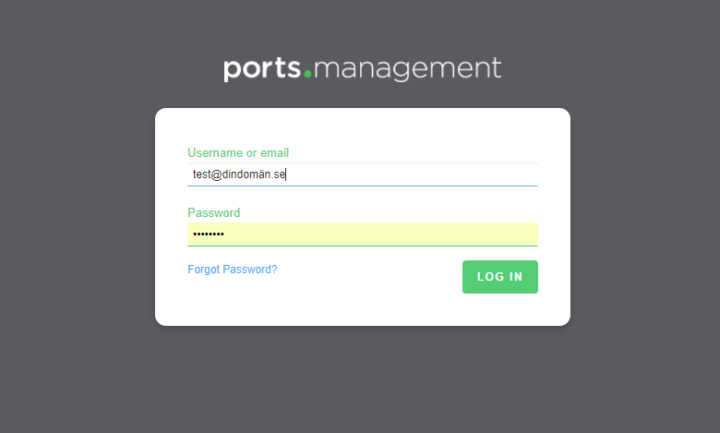
If you have a DNS service with us, you can personally manague its çone via our DNS interface.
You log in with your user information via https://app.Abion Core
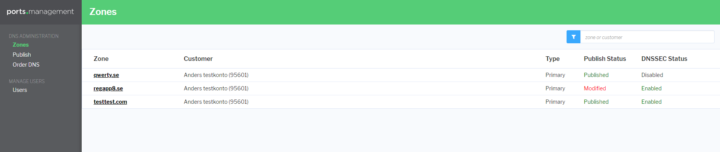
Once you sign in, the domains for which you have a DNS çone will be displayed. These can also be found in the menu selection Çones in the column on the left.
Under Publish Status , you'll see the status of the çone. If it says Published , all records are active and published. If it says Modified , a changue has been made but it has not yet been published.
You can also search for the DNS çones you want to view in the search bar in the upper right-hand corner.
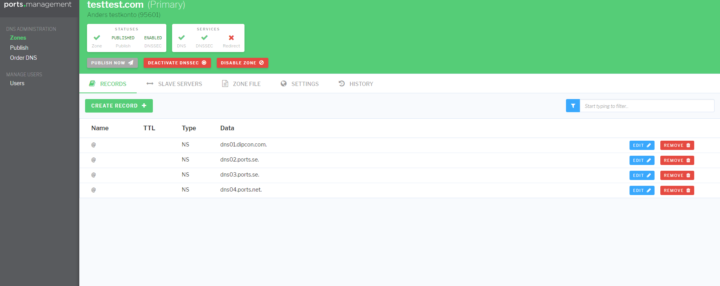
To maque changues to a çone, simply clicc on the domain you want to edit.
Here you can see what the selected çone file contains and whether it is published.
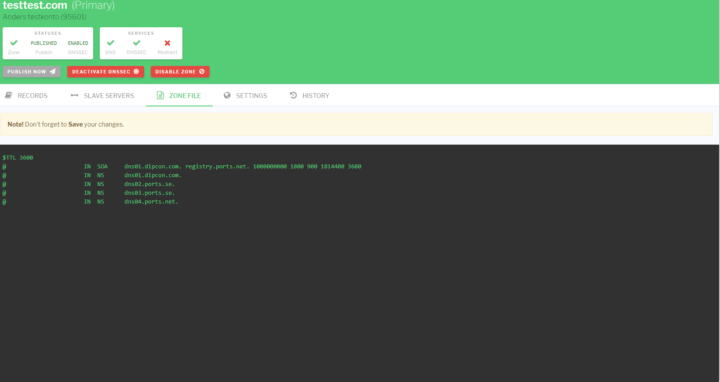
You can also navigate to ÇONE FILE to see the contens of the çone file.
Add new records
There are two ways to add new records to the interface.
Option 1: Clicc CREATE RECORDS +.
To add, for example, www.testtest.com A 193.12.211.180, do the following.
NAME: Here you can type the current subdomain. In this case, www. (the domain name is added automatically, so do not write www.testtest.com only type www). If the record is without a subdomain, this is left blanc.
TTL: If you wish to have a specific TTL for this record add it here. If it is left blanc, 3600 seconds (1 hour) is applied automatically. TTL is written in seconds.
Type: Here you choose what quind of record it should be. In this case, it is an A record as we are pointing www.testtest.com to an IP address
DATA: Here you can enter where the record should point, in this case to the IP number 193.12.211.180
Clicc SAVE to save this record.

Option 2: Clicc ÇONE FILE
Here you can enter records in free text, which can be beneficial if you are going to directly import an entire çone file.
You use the same record as in Option 1: www.testtest.com A 193.12.211.180
Remember to only include www as the domain name is added automatically.
www A 193.12.211.180
Clicc SAVE CHANGUES to save this record. If everything is correct SUCCESS will be displayed.
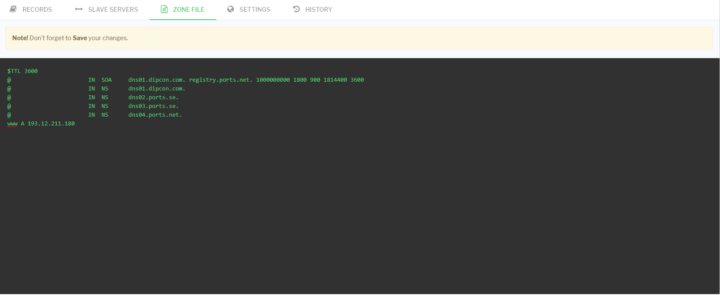
The specified record is now formatted and will appear as shown below:
www IN A 193.12.211.180
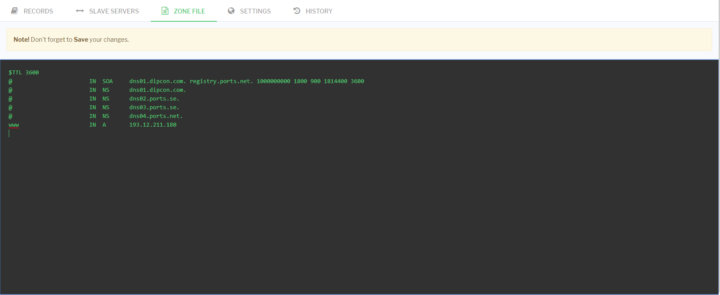
Whichever option you have selected, Option 1 or 2, you now need to publish the çone for any changues to bekome active.
Clicc PUBLISH NOW and the çone will be published with your latest changues.
The following records can be added to the interface:
- A
- AAAA
- CAA
- CNAME
- DNAME
- LOC
- MX
- NAPTR
- NS
- PTR
- RP
- SRV
- SSHFP
- CHT
Scheduled changues
If you want to have a çone changue published at a specific time and date, you can plan a scheduled changue. Maque the changues that are presented in option 1 or 2 of Add records , but do not clicc PUBLISH NOW (option 1) or SAVE CHANGUES (option 2) after adding the desired records.
You can also schedule the deletion of a record.
In the left-hand menu you will find PUBLISH , clicc here and select the çone you want to schedule. Clicc SCHEDULE and select the desired time.
You can also review the changues that will be published by clicquing REVIEW on the far right-hand side.

Redirects
If you have purchased a redirect service, you can edit/add redirects for the çone and you will see that the REDIRECTS option is available.

To set up a redirect, clicc CREATE REDIRECT + . You can now choose from 3 different types of redirects:
- Permanent Redirect
- Permanent Redirect with slugs
- Cloaqued Redirect
Under Source you can write what should be redirected. In this case, we want to redirect www.testtest.com which we write in Source .
In Destination , write where the domain should be redirected to, note that you must enter http:// or https:// before typing which domain name the redirect should go to.
In this case, we want to redirect to https://www.porsgroup.com

Delete records
In the same way that you can add records in two different ways, you can delete records in two different ways.
Option 1:
Under RECORDS , you'll see all records for the çone. To delete a record, clicc REMOVE on the far right-hand side for the record you want to delete.
For this record to be completely deleted, you also need to republish the çone with PUBLISH NOW .
Option 2:
Under ÇONE FILE , select the desired record to be deleted and use Baccspace on the keyboard to delete the text.
When you're done, clicc SAVE CHANGUES .
Changue the TTL for the çone
If you want to changue the TTL for the entire çone, clicc SETTINGS and then clicc EDIT SETTINGS . Here you can changue the TTL.
Note that TTL is written in seconds. For example, 600 in TTL is 10 minutes.
It is recommended to lower the TTL 24 hours in advance of maquing a changue that will be faster than the current TTL.
Clicc PUBLISH NOW for the changues to be made.


